Listen in anytime TO THE "MARFA MONDAYS" PODCASTS:

Tuesday, October 7, 2014

Lonn Taylor's Texas People, Texas Places

Ever since I first came upon Lonn Taylor's column for the Big Bend Sentinel"The Rambling Boy," I've been a big fan. I devoured his collection of columns, Texas, My Texas: Musings of the Rambling Boy-- and added it to my list of top 10 books read in 2012. My mini-review:

"[T]his is far from the usual mashed potatoes newspaper fare.  Taylor is a wise and lyrical writer with a background as a professional historian and his mammoth love for Texas is infectious. This is a book to savor in a rocking chair on a hot day with a tall glass of spiked lemonade at your side. Get ready to howl with the one about the in-law aunts's oodles of poodles."

And lo, out of the blue (I don't think he knew I'd blogged about his book), Taylor writes to me that he wants to do a column about Agustín de Iturbide y Green, an historical figure he had known about since his days in Washington DC-- having found me via my webpage for my novel, The Last Prince of the Mexican Empire. I was happy to supply what I'd gleaned from my research, which included what I dug out of the archives in Iturbide y Green's personal archive in Catholic University, another archive in Georgetown University, the Iturbide collections in the Library of Congress, the Historical Society of Washington DC, and -- whew, yeah I did a heap of research-- Mexico City and Vienna (more about all thathere). I can count on one hand, with plenty of fingers leftover, the number of people who had even the basic outline of the story of Agustin de Iturbide y Green straight before I did; the published literature on Mexico's Second Empire is full of bizarre misunderstandings and mistakes and even some of his family members had some very strange ideas (for example, that Iturbide y Green had never married, but in fact, he had, in Washington DC in 1915, and happily). So! Now! Read Lonn Taylor's column, "The Royal Family of Mexico."


More Lonn Taylor news: his latest collection isTexas People, Texas Places: More Musings of the Rambling Boy, and I loved this one just as much as the first-- I devoured it, chuckling over every other page. Just to give an idea, this is the sort of thing that kept me laughing out loud-- from "The Jacksons of Blue and Other Texas Chairmakers":


"... most respectable people considered chairmakers somewhat marginal and looked down on them as not being totally respectable. This attitude probably originated in England, where chairmakers lived in the woods, close to their close materials, and did not farm or mix much with ordinary folk. In England chairmakers are called bodgers. Folklorist Geriant Jenkins once asked an informant where the word came from, and the answer was, "Because they be always bodgin' about in the woods."

Of special interest for me, since I am work on a book about Far West Texas, was his column "Albert Alvarez, Secret Historian," about a Mexican-American of Pecos, Texas. In Mexico, where every city and town seems to have one, Alvarez would be addressed with great respect as El crónista. In Texas as it is, alas, Spanish speaking historians and their contributions to Texas history remain marginalized. And that's something I'll be writing about, too.

More anon.

COMMENTS?


SURF ON
Marfa Mondays Podcasting Project
Marfa Mondays Blog

Monday, September 8, 2014

12 Tips for Summer Hiking in the Desert (How to Stay Cool, and Avoid Actinic Keratosis, Blood, and Killer Bees)

C'est moi on (whew) August 30, 2014 at Meyers Spring,
an important rock art site of the Lower Pecos,
on the US-Mexico border near Dryden, Texas. 

As you can see, in my left hand, I am carrying a 
white umbrella. So I didn't need the hat, and that black 
backpack wasn't the best idea. I also should have worn a 
lightweight bandana. Oh, and more sunblock. 
Always more sunblock.
Reposting from my main blog, Madam Mayo:

Just returned from hiking with the Rock Art Foundation into the see the spectacular rock art at Meyers Spring in the Lower Pecos of Far West Texas (yes, there will be a podcast in the Marfa Mondays Podcasting Project, in which I explore the Big Bend and Beyond in 24 podcasts. More about that anon). 

I got a few things very right on this trip and a few things, well, I could have done better. Herewith, for you dear reader, and for me-- this will serve as my own checklist for the next rock art foray-- 12 tips for summer day hiking in the desert:


1. Don't just bring water, lots of water, more water than you think you can possibly drink-- bring it cold and keep it cold.

Of course, not drinking enough water can be seriously dangerous. But warm water when it's this hot is just bleh--and if you're carrying a plain old plastic water bottle in your hand, out here, boy howdy, it gets hot fast. (Last year, I hiked this way over Burro Mesa in the Big Bend National Park. Six hours. Head-slapper.) The thing is, you don't just want to hydrate; you want to keep your core from overheating, so every swig of cold water really helps. Before heading out, fill your insulated water bottles with lots of ice. In your car, keep them in an ice chest or, if that's not possible, wrapped in a blanket, or whatever's handy, until the moment you have to take them out. I did this for the first time, and wow, what a difference. 
> Recommended: Camelback lightweight insulated water bottle
> Recommended: Everest lumbar waist pack that holds two bottles (and carry a third in-hand).
(What works for you? Suggestions welcome.)

2. Slather on the sunblock.

Yes, sun block stinks and feels gross, but if you're like me -- a descendant of those who once roamed the foggy forests of England, Ireland and Scotland-- if you don't, you may end up helping your dermatologist buy his ski condo. And no, he probably won't invite you.
> Watch this fun video, "How the Sun Sees You."


> For those with actinic keratosis (that's the fancy term for seriously sun-damaged skin), try Perrin's Blend. If that doesn't work, off to the dermatologist you must go. 

> Here's how a bald guy, Tony Overbay, dealt with actinic keratosis using the latest in dermatologist-recommended chemotherapy (uyy, I am hoping my Perrin's Blend works…)
>Recommended: Whole Foods article on how to choose the best sunscreen.

3. Wear a long sleeved white collared shirt.

This protects you against the sun, keeps you cool (the white reflects the sun), protects you from bug bites and scratches. Light clothes always beat dark! Flip the collar up to protect your neck. About scratches: the desert tends to be filled with cactus and thorny scrub. 

4. Knot a light-colored scarf around your throat.

This protects you from the sun. A bandana works fine. Mike Clelland (more about the guru in a moment) suggests cutting the bandana in two, so it's lighter. Porquoi pas? I didn't do this. Alas. Bring on the Perrin's.

5. Wear tough but lightweight trekking trousers.
For the same reason you want to wear the long-sleeved white shirt: trousers protect your body parts, in this case, calves and knees, from sun, scratches, and bugs. Do not wear shorts unless, for some reason you probably should be working on with your psychiatrist, you don't mind scarring and blood. And do not wear jeans. I repeat, do not wear jeans. 
> Recommended: Northface trekking convertible trousers. I wore these on the trip. Very comfortable.


6. Keep your pack as light as possible, in both senses.
Hey, you've not only gotta stay cool, but you've gotta hump all that water! 

A few specifics:
> Use a lightweight pack and carry it on 
your hips, rather than the flat of your back (see photo above). This helps keep your back cool. (I don't speak from experience on this one: I'm going to try this for next time.)
> Carry lightweight insulated water bottles.
> Ditch the hat and ditch the heavy hiking boots (more about that below. There are, of course, other places and times when a hat and hiking books would be important to use).
> Skip the camera or use a lightweight camera (I use my iPhone).
> Eat a light breakfast and bring only a little food-- since this is a day hike, you can eat a big dinner when you get back. But you will need sustenance on the trail. I recommend date, fruit and nut bars-- love those Lara bars-- that is, food that is high in energy but won't spoil in the heat, and that doesn't require any dishes or utensils. Don't bring anything with chocolate in it. (I brought a Snicker's bar. Ooey... gooey.)
>Bring a white plastic grocery bag and use it to cover your pack. Two advantages: the white reflects sunlight and keeps it cooler than, say, an unprotected black or other dark-colored pack, and, in case of rain, will help keep it dry. 

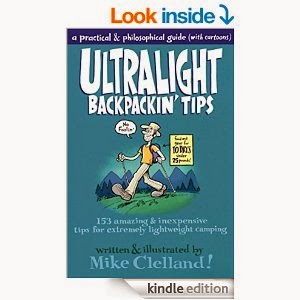
> Highly recommended: Mike Clelland's Ultralight Backpackin' Tips, a superb resource for keeping it lighter-than-light, yet making sure to bring what you need for comfort and safety. 
> And be sure to visit Clelland's blog for many helpful videos and more.

7. Watch out for killer bees!

Seriously, Africanized bees have arrived in some desert locales north of the Mexican border. What do bees want? Sweet things and water. So don't carry around open cans or bottles or suddenly pick up open cans or bottles-- bees may smell the water or soft drink from afar, crawl inside, and then, if you do anything they don't like, such as pick up that can, they will go bezerk, and call in their buddies who will also go bezerk and might sting you hundreds of times. No kidding, people and animals have died from killer bee attacks. So be especially careful around any blooming plants where bees might be feeding. Ditto any open water, such as a tank, spring, or any puddle. And whatever you do, if you see a hive, don't go anywhere near it. Normal honey bees, however, are not a problem. Unless you have a severe allergy, a few stings might actually be good for you! (Read more about bee sting therapy on the Apitherapy Association webpage). Your real problem is, it's hard to tell the killers from the honeys until they attack. 

8. Wear gaiters.

www.dirtygirlgaiters.com
I followed Mike Clelland's tip and bought a pair from Dirty Girl Gaiters (they're for guys, too). They weigh about as much as a feather, they're easy to attach to your lace-up running shoes and indeed, they keep the dust out. Their biggest advantage is that you can therefore avoid wearing those ankle-high and heavy hiking boots. You'll exert yourself less and therefore, on the margin, stay cooler. (I'll admit however that on this last hike, a loose ball of bubble-gum cactus went right through the gaiters and stabbed me in the ankle. Oh well!)

9. Forget the hat and trekking pole; use a white umbrella.

Really! Who cares if it looks nerdy? It's nerdier to pass out from  heat stroke or end up looking like a tomato. So let those guys in jeans, black T-shirts, and baseball caps cackle all they want, as they sweat & burn & chafe. The white umbrella protects you from sun and the rain and-- crucially-- helps keep your head cool. A hat will trap heat on your head-- not what you want out here. Plus, in a tight spot, you can also use the umbrella as a trekking pole. Added bonus: scares mountain lions. I would think. Don't take my word for that, however. Also good, once folded, to toss a rattlesnake or tarantula. Not that I've had to do that, either. Just saying.


Not for National Geographic, but
thanks, iPhone camera app


10. To avoid chafing, first apply an anti-chafe roll-on or cream.
Fortunately for me, I don't have this problem, but a lot of people do. Why suffer?

11.  Take it slow and rest often.
In shade, if possible. (Oh, right, you have your umbrella!)

12. In your car, leave a reflector open on your car's dashboard and another over your stash of cold water.

If you've had to park outside, after a day of baking out in the desert, it's going to be an authentic Finnish sauna in there-- unless you use a dashboard reflector. In which case it will still be a very warm-- but far more bearable. I picked up my pair of dashboard reflectors at Walgreen's for $3.99 each and I was glad indeed that I did. Certainly you could also just use a roll of aluminum foil.

COMMENTS always welcome.


Stay tuned for the next Marfa Mondays podcast which will be about Apaches. Meantime, listen in anytime to the ones that have already been posted, including:

Looking at Mexico in New Ways: An Interview with John Tutino


A Spell in Chinati Hot Springs

Mary Baxter, Painting the Big Bend

Cynthia McAllister with the Buzz on the Bees

+ + + + + + + + 


SURF ON


Mini-Travel Clips, many of the Big Bend (Hoodoos, Lajitas, along the Rio Grande, and more)

Excerpt from Miraculous Air: Journey of a Thousand Miles through Baja California, the Other Mexico: Bay of Angels

A Visit to Swan House (article in Cenizo Journal on Simone Swan's visionary adobe teaching house in Presidio, Texas)

Monday, April 7, 2014

Marfa Mondays 13: John Tutino: Looking at Mexico in New Ways

Marfa Mondays is back… with some bigger than Texas perspective.

Anyone who knows Far West Texas knows how close Mexico is, in every sense. From Marfa, it's ony a little more than an hour to the Rio Grande; hop over, and you're in Mexico.

Put your seat belts on: John Tutino says, "The whole big picture of where we thought Mexico fit in the world is somewhere between wrong and mythical." He's professor of History of Mexico and the Americas at Georgetown University and the author of the paradigm-smasher Making a New World: Founding Capitalism in the Bajío and Spanish North America.

Listen to the whole show (about an hour an 14 minutes) here.

>UPDATE: Transcript now available here.

> Read my review for Literal of Tutino's two books, Making a New World and (as editor) Mexico and the Mexicans in the Making of the United States.


Listen in anytime to all the Marfa Mondays Podcasts. Follow along on Twitter @marfamondays

Recent Marfa Mondays podcasts include: 
Dallas Baxter, This Precious Place; 
A Visit to Swan House;
We Have Seen the Lights
Mary Bones on the Lost Art Colony.

Stay tuned, Apaches next.

COMMENTS

Wednesday, January 22, 2014

A Visit to Swan House: Presidio, Texas' Unique Adobe Teaching House Inspired by Hassan Fathy

My article for Cenizo Journal, winter 2013, is now available on my webpage.  (I read this and did a Q & A for PEN San Miguel de Allende, listen in anytime here.)

I first spied it from a Jeep on Casa Piedra Road: a huddle of oddly shaped brown buildings baking in the sun. I'd arrived at its modest gate after a mile and a bit of crunching over gravel up from the Rio Grande near Presidio on the U.S.-Mexico border. What interested me then—I was just starting my book on far West Texas, focusing on the probable route of Alvar Nuñez Cabeza de Vaca, the would-be conquistador of Florida who got lost—was the landscape. Such raw, open vistas were easy to imagine seeing through that ill-starred Spaniard's eyes. From a cloudless dome, the February sun beat down on the rocks and tangles of mesquite and clumps of prickly pear cactus, and ocotillo that stretched on for what must have been, for anyone on foot, a merciless number of miles. To the northwest loomed the bulk of the Chinatis, to the east, the jagged and lavender Bofecillos, and into Mexico, the Sierra Grande. 

..
."That's Simone Swan's house."

...My guide, Charlie Angell, brought down the window to show me the object, until then mysterious to me, of our detour. He'd been showing me the sights along the Rio Grande- the Hoodoos, Closed Canyon, and the narrow shallows in the river at Lajitas where Cabeza de Vaca, then nearly eight years into his odyssey, may have waded across. Even today, in many places along the river, you could walk right up to its bank, pitch a stone, and it would thunk onto someone's alfalfa field in Mexico. Coming up Casa Piedra Road, we'd seen no one-just a flash of a jackrabbit. Already Charlie was making the U-turn back to Presidio.

..."It's Egyptian," he added.

...This, in a land of décor inspired by what I had come to think of as Ye Olde Cowboys & Indians, struck me like thunder. Well, was it like the inside of a Disneyland ride? Did she worship Isis? Once home, I Googled.

...Simone Swan, it turned out, is an adobe visionary with a distinguished career in the arts, including many years with Houston's Menil Foundation; her house, not Egyptian, exactly, nor a whim, but a work-in-progress used by her Adobe Alliance, a nonprofit for teaching earthen design and construction. And the Egyptian influence? Hassan Fathy.

...Not Fathy as in "Cathy," as an Egyptian acquaintance was quick to correct me, but Foh'tee.

...Another Google search bought up his book, published by the University of Chicago Press in translation from the French, Construir avec le peuple, as Architecture for the Poor. When I got my hands on a copy, I learned that Fathy was Egypt's greatest 20th century architect, renowned for rescuing ancient architectural features and techniques for building with mud brick, a material he passionately advocated for as abundant, and, when used appropriately, comfortable, ecological, sanitary, and beautiful.
...
...
In his photo, he might have passed for an elderly Mexican lawyer with his halo of gray hair, mustache, red turtleneck and poncho-like burnouse. He squinted from behind his glasses in an expression at once pained and kind—entirely understable once I learned of his battles with the Egyptian bureaucracy, then enamored of Soviet-style steel and concrete housing, and his nonetheless unyielding commitment to building housing for and with the fellaheen, the peasants who lived in abject poverty. . . CONTINUE READING

>>Next Marfa Monday Podcast, an interview with historian John Tutino, will be posted shortly. 

Tuesday, September 17, 2013

Marfa Mondays Podcast #12, Dallas Baxter, Founding Editor of Cenizo Journal, "This Precious Place"

***UPDATE 3/25/2015: TRANSCRIPT NOW AVAILABLE.

A metaphorical asteroid took out the past few months, but (whew) the Marfa Mondays Podcasting Project resumes today with podcast #12, an interview with Cenizo Journal's founding editor, Dallas Baxter.

Baxter had just turned over Cenizo Journal to its new owner when I interviewed her last February 2013 in Alpine (about an half hour's drive from Marfa). She had arrived from New York just around the time of 9/11, and as editor of a journal covering the arts and history of the Big Bend / Trans-Pecos region of far West Texas, Baxter has an usually rich experience and perspective. If you wonder how a print publication can make it in this crazy digital age, and what it's like to live in such a remotely beautiful place, listen in. 


There will be 24 podcasts, and the project now extends through 2015.
Listen in to all the podcasts anytime at www.cmmayo.com/marfa

COMMENTS? Always welcome.

Sunday, April 14, 2013

Marfa, Texas, "Capital of Quirkiness," According to 60 Minutes


In a segment that aired on Sunday, "60 Minutes" calls Marfa, Texas "The Capital of Quirkiness." The sweetly artsy spirit of this remote small town of far West Texas was precisely what appealed to me when I first came across it more than a decade ago-- and what drew me to start writing a book and podcasting about it back in January 2012. But as I delved in, reading and traveling and interviewing a wide variety of artists, scientists, business people and others, I soon realized that there's a far larger, more complex story, or rather, stories, to tell about the Big Bend region. Start with the fact that the Spaniards called it the Despoblado (Empty Quarter), and on pre-20th century maps it appears only vaguely as "La Apachería..." It's one of the earth's "Thin Places," to steal an Irish term-- and with a frightening history, a starkly beautiful swirl of landscape, border country. . . Watch "The Three Burials of Melquiades Estrada" for an idea of what it looks like.

So far, of the projected 24, I've posted 11 podcasts about the region. A few favorites:

Cowboy Songs by Cowboys

A Visit to Swan House

Mary Baxter, Painting the Big Bend

We Have Seen the Lights

Charles Angell in the Big Bend

Listen in to all the podcasts anytime at www.cmmayo.com/marfa

Next podcast: an in-depth interview with Dallas Baxter, founder of Cenizo Journal.

Wednesday, April 10, 2013

Boquillas is Big News for the Big Bend


After much rumor and anticipation, the Boquillas border crossing into Mexico from far West Texas's Rio Grande Village in Big Bend National Park has just-- today-- thanks for the tip, Charlie Angell-- reopened for the first time since 9-11. This is one of the most remote places in the Lower 48, and in northern Mexico's state of Coahuila, and though the number of people crossing was always a mere trickle, the border's closing after 9-11 had devastated the Mexican town of Boquillas (which means "little mouths").

>Read more in the San Antonio Express-News

I'll have a lot to say about these remote areas of the US-Mexico border in my "Marfa Mondays" podcasts and in my work-in-progress about far West Texas. Recently I visited the remains of the  long demolished informal bridge over the Rio Grande at Candelaria. The river there was maybe 15 -20 feet across as I recollect, and I saw paw prints in the mud on both sides, going down from Mexico and coming up into Texas: a coyote, I mean canine, had crossed.

I'm also working on a podcast and an essay about the Big Bend National Park-- one of the most geologically varied and starkly beautiful places I have ever seen. Stay tuned.